
Sleep Lab · Bedding & materials · 4 min read
How do I wash a memory foam pillow without ruining it?
You wash the cover and you air the core. Memory foam is not ruined by use — it is ruined by water, and the two halves of a pillow are cleaned in two completely different ways.
What should you start with?
Sweat, skin, hair oil and the humidity of eight sleeping hours land on the cover. Almost none of it reaches the foam, because the cover is doing the job a cover exists for. That is why the answer is not one method but two: a fabric that wants water and soap, and a foam core that wants air and nothing else.
People usually discover this the wrong way round. The cover is what smells, so the cover gets washed — fine. Then the foam gets washed too, because it smells faintly of the same room, and that is the step that shortens the pillow's life. The core is not dirty in the way fabric is dirty. It is damp, and damping it further is the problem.
What does water do to the foam?
Memory foam is polyurethane with an open cell structure: the cells are meant to hold air, and they hold water just as readily. Once soaked, a pillow holds water deep inside where air cannot reach it — days of drying, not hours. While it is wet it also loses the structure that lets it spring back, and weight pressed into wet foam leaves a shape that stays.
Heat makes both problems worse. A tumble dryer drives moisture deeper before it removes it, and the heat itself is the part foam tolerates least. This is why our own care card, printed with the pillow, says what it says: spot clean the core with a damp cloth, then air it in the shade, never soak it, never leave it in direct sun. Four short instructions that cover the whole failure list.
Is the cover the easy half?
The cover is a genuinely washable thing, and we print the same five lines on both pillows. Machine wash cold, 30°C maximum. Do not bleach. Line dry in the shade. Do not tumble dry. Iron the cover only, on the lowest setting. Close the zip before it goes in the drum — an open zip is the one part of a cover that can catch on something else in the load.
The two covers are not the same fabric, so read the label rather than assuming. Curve's cover is a knit: the top face is 90% polyester with 10% elastane, and the sides and base are 100% polyester. Gel's cover is a grey knit cotton that zips off. Same washing lines, different cloth — which is exactly why the instruction lives on a label instead of in a memory.
What are we not going to print?
We are not printing a named machine programme, a detergent brand, a spin speed or a drying time. We have not tested those combinations ourselves, and a wash instruction that fails quietly is worse than none — you only find out a year later, when the pillow has gone flat in one spot. We are also not quoting reviews here: every English page we found on washing foam pillows was written by someone selling protectors, mattress covers or the pillows themselves.
We will also not claim that a wash cycle does anything beyond removing soil and oil from fabric. What a pillow holds after years of nights is not a laundry question, and a page about zips should not pretend to answer it.
What routine keeps it out of the machine?
- Wash the cover, not the pillow. Unzip it, close the zip, wash at 30°C maximum, line dry in the shade. The foam stays out of the drum entirely.
- Spot the core. A damp cloth on the surface, then air it flat. If something has soaked in, air it longer rather than scrubbing harder — rubbing wet foam moves the damage around instead of removing it.
- Air the core every month or so. Take the cover off and let both halves sit in shade with air on them. A pillow that never gets air keeps every night of humidity inside it.
- Keep both out of the sun. Direct sun is the other common way to end a foam pillow early. Shade with moving air does the same job more slowly and without the cost.
- Rotate the pillow. Head, neck and shoulders load the same area every night. Turning it end to end spreads that load and keeps one spot from going flat first.
When will washing not fix it?
If the cover comes out clean and the pillow still smells, the smell is in the foam, and repeated washing will not reach it. If the foam has gone soft in one place, or stays compressed after you press it, that is structure that has already gone — it does not come back with care. Care keeps a good pillow good; it does not rebuild one.
Where do these lines come from?
The care card in the photo ships with the pillow, and it is the source for every number on this page.
 AERÉ Curve
A butterfly-shaped memory foam pillow with two shoulder notches and two heights in one. $79.00.
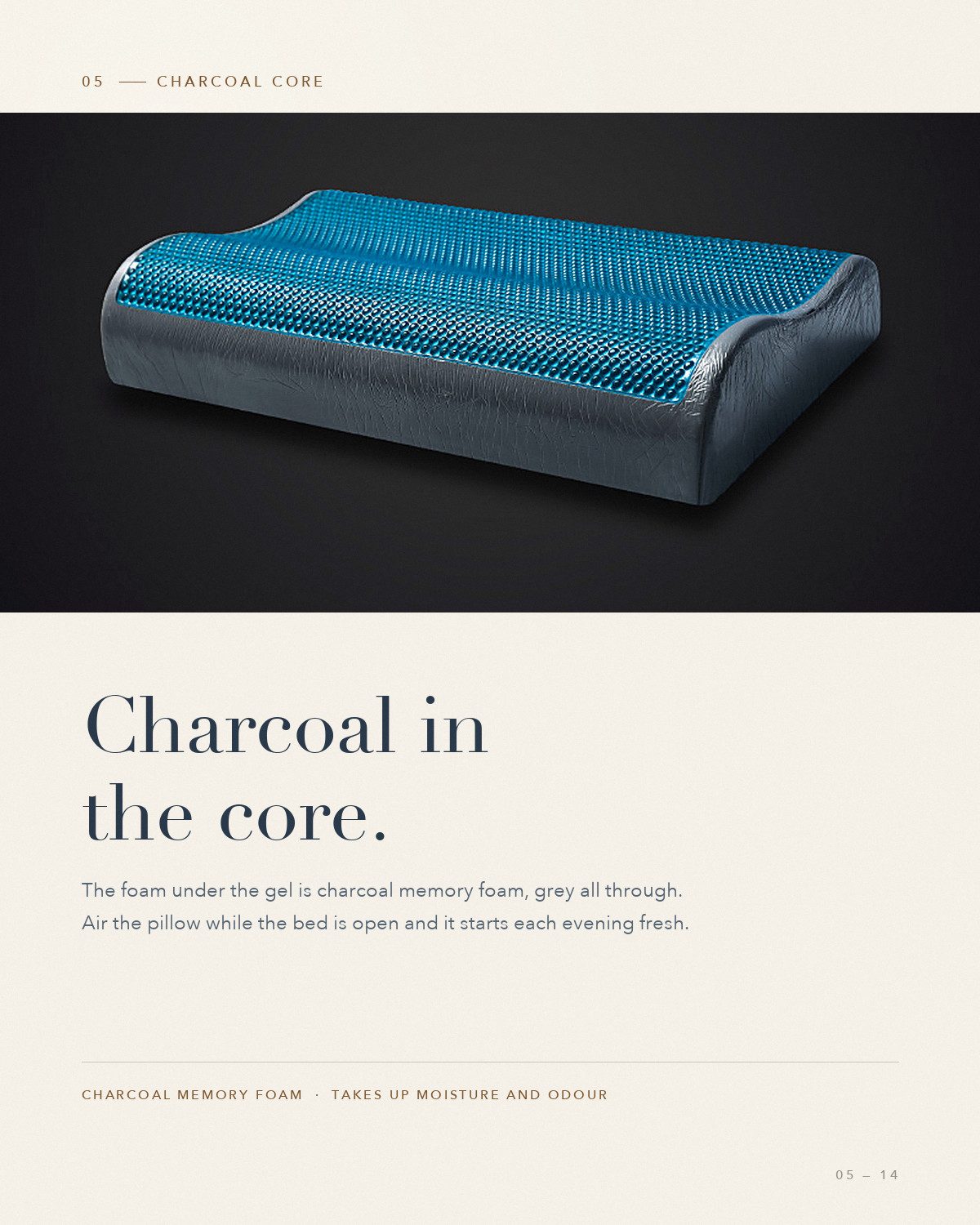 AERÉ Gel
Cooling gel bonded to charcoal memory foam, cut in a wave for the neck. $139.00.
About AERÉ
AERÉ is a sleep and everyday-wellness home brand based in Hangzhou, China, designing twenty things for the hour before bed.
Questions people ask next
Not the foam. The cover unzips and washes at 30°C maximum, but the core should never be soaked — it holds water in cells that air cannot reach, and wet foam loses the structure that makes it spring back. Spot clean the core with a damp cloth and air it flat in the shade.
As often as you would wash a pillowcase, and more often in a warm room or if you sleep without one over it. The cover takes the sweat and oil; the foam underneath only needs air. Washing the cover regularly is the single thing that keeps the core out of the equation.
The smell is in the foam, and a surface wash will not reach it. Air the core flat, out of the cover, in shade with moving air for a few days and see whether it fades. If it does not, the foam is holding something a wipe cannot remove — at that point the honest answer is a new pillow, not another wash.