
Sleep Lab · Habits & environment · 6 min read
What is the best bedroom temperature for sleep?
Every page on this subject hands you a number, and almost none of them arrive with the study that produced it. Here is the one bedroom figure we could put a source on, why it does not transfer to your room, and the order in which to change things when the room is the problem.
What is the number everyone quotes?
Ask what temperature a bedroom should be and you get a figure. Different pages give different ones, all stated with the same confidence, none of them carrying the study that produced them. We are not going to add another one to the pile.
There is one number we can put a source on. In a national survey in France in 2026, run through a heatwave, people whose bedroom was above 21°C took 46 minutes to fall asleep. Below that line, 31 minutes. The survey is from INSV, the French national sleep institute, and the timings are self-reported.
One country, one summer, self-reported. That figure describes a difference between two groups of people. It is not a target for your bedroom, and we are not going to turn it into one.
Why can your room not borrow a number?
Air temperature is one of five things acting on you at the same time, and it is not the one closest to your skin. What you are lying on decides how much heat stays where your body presses down. What is over you decides how much can leave. How fast the air moves decides how much leaves per minute. How much water the air already holds decides how much more it can take. What you are wearing sets the starting point before any of the other four.
Two bedrooms can both read 20°C and feel like different rooms, because the thermometer is measuring air while you are measuring a microclimate: a pillow, a mattress, a duvet and a sheet, each holding whatever it has been given.
What order should you change things in?
- Measure the room at pillow height, in the middle of the night. A thermostat in a hallway reads the hallway. Put a cheap thermometer on the empty side of the mattress and read it once at three in the morning, three nights running. That reading is your baseline; everything below is a test against it.
- Move air before you cool air. A fan changes what your skin can lose without changing the temperature of anything in the room. Two openings on opposite walls do the same job for nothing. Cooling a whole house to change one room is the most expensive version of this.
- Take something off before you turn something down. A winter duvet in a 20°C room is a warm bed. Most people reach for the thermostat before they consider the tog, the fill, or the second blanket.
- Check what is under your head. Memory foam is dense, and dense things hold heat where the head presses into them. If the back of your neck is damp at three in the morning while the room reads 20°C, the room is not what is wrong at that spot.
- Change one thing, then give it three nights. Four changes in one night tell you nothing, because you cannot tell which one moved. One change, three nights, then decide.
Why is the room at three not the room at eleven?
A bedroom is not a fixed environment. The heating goes off, the outside temperature drops, a door gets closed, a second person comes to bed and adds their own heat to the same mattress. A setting that is right when you get in can be wrong four hours later, and the hour you wake is usually the hour that tells you so.
That is the reason to read the thermometer at three rather than at bedtime. The number that matters is the one in the room you are actually asleep in, at the hour you are actually asleep in it.
What will we not print?
We will not print a recommended bedroom temperature. The pages that do tend to cite each other, and a figure repeated often enough starts to look like a finding.
We will not tell you a pillow cools a room either. The gel layer and the knit face on Gel move heat away from one small area, the back of the head, and that is the end of the claim. A cool pillow in a warm room is still a warm room.
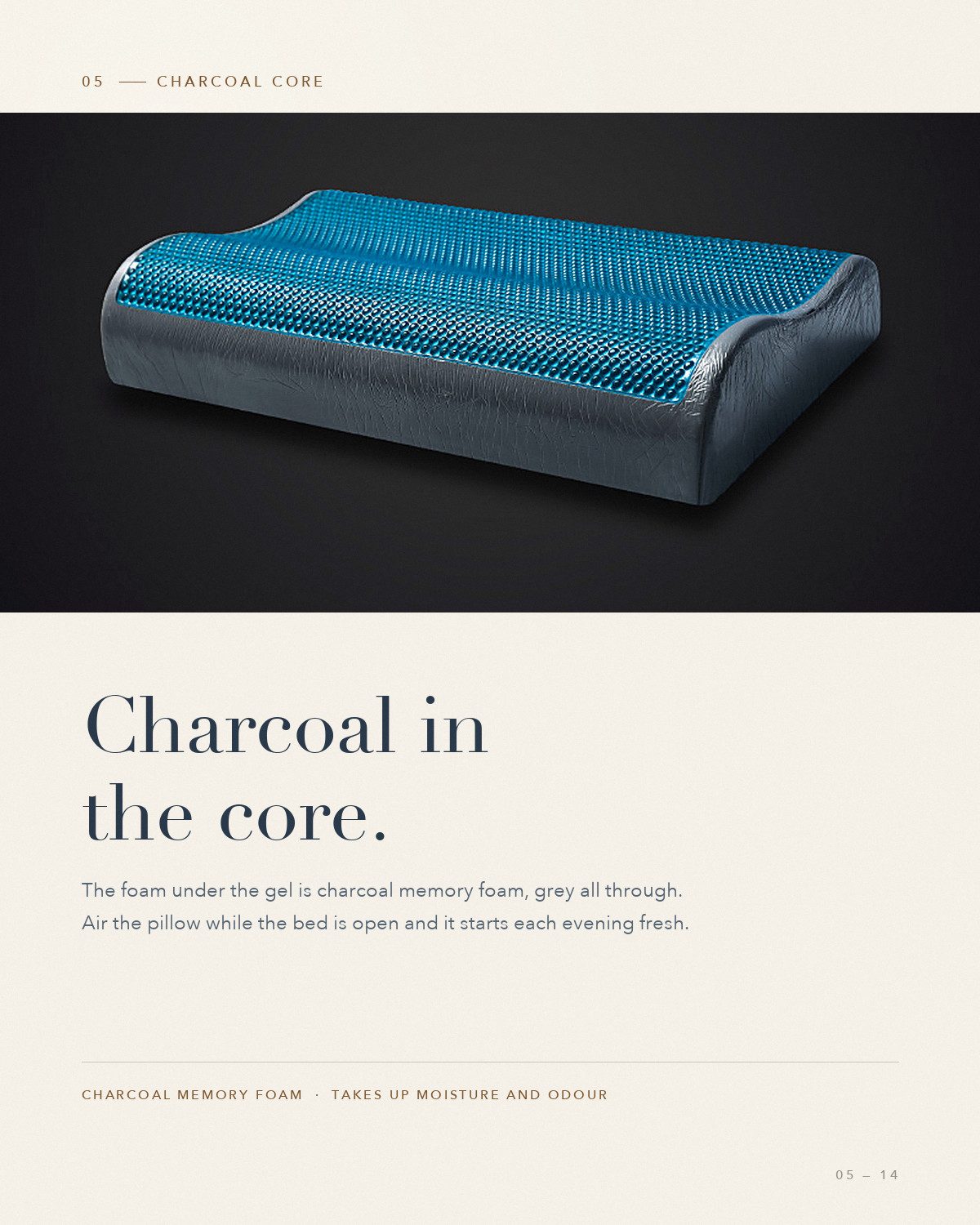 AERÉ Gel
Cooling gel bonded to charcoal memory foam, cut in a wave for the neck. $139.00.
About AERÉ
AERÉ is a sleep and everyday-wellness home brand based in Hangzhou, China, designing twenty things for the hour before bed.
Questions people ask next
It is the most repeated figure and we cannot source it, so we do not print it as a recommendation. Take any single number as a starting hypothesis for your own room, then measure at pillow height for three nights and see whether your nights agree with it.
A fan does not lower the temperature of the air. What it changes is how much heat your skin can give up, which is why moving air feels different from still air at the same reading. Point it at the bed rather than at the ceiling, and if the noise keeps you awake, that trade is worth noticing.
Warmth is one possible reason among several, and a warm room is easy to test: feel the back of your neck and the sheet under you. If both are damp, work on the surfaces and the air movement first. If you wake at the same hour whatever the room is doing, that is a different question and a different article.